Brakes rarely fail all at once. They wear a little every time you stop, and the car usually tells you long before anything lets go: a noise that was not there last week, a pedal that feels different, a pull to one side at a junction. Because we drive the same car every day, we adjust to small changes without noticing them.
This guide runs through the signs that your brakes need looking at, explains what the pads, discs and fluid do, and sets out how the DVSA inspection manual says an MOT tester checks brake condition and performance. Every MOT fact comes from the GOV.UK pages listed at the end.
Squealing and grinding: what the noises mean
A high squeal when you brake is the most common sign of worn pads. Many pads carry a small metal wear indicator that touches the disc when the friction material is nearly used up, and the squeal is that tab doing its job.
Grinding is different. A harsh metallic scraping on every stop normally means the friction material has gone and the pad backing plate is pressing on the disc, damaging it. The DVSA manual treats a pad worn down to its wear indicator as a major defect and a pad worn below 1.5mm as dangerous, so grinding is also a failed MOT waiting to happen.
Longer stopping, pulling to one side and a pulsing pedal
If you are pressing harder or braking earlier than you used to, the brakes are losing efficiency. The MOT measures this: service brake efficiency must reach 58% for most cars first used on or after 1 September 2010, and 50% for earlier cars and light goods vehicles. Below that is a major defect.
A car that pulls to one side when you brake has brakes working unevenly across an axle. The Highway Code says this is most likely a brake fault or incorrectly inflated tyres, and that you should consult a garage or mechanic immediately. On the MOT, a wheel giving less than 70% of the effort of the other wheel on the same axle is a major defect, and under 50% on a steered axle is dangerous.
A pedal that pulses under your foot, often with a shake through the steering wheel, usually points to a disc that has worn unevenly or distorted, what most people call a warped disc. The manual lists excessive fluctuation in brake effort through each wheel revolution, and a brake grabbing severely, as major defects.
A spongy pedal, the brake warning light and handbrake travel
A soft or spongy pedal, or one that sinks further than it used to before the brakes bite, means a problem in the hydraulics rather than at the wheels: air in the system, a leak, or fluid that is past its best. The MOT fails a car whose pedal reaches the floor, and a leaking master cylinder is a dangerous defect.
The red brake warning light is shared on many cars between the handbrake, low fluid and worn pads. The Highway Code is blunt: understand what each warning light means, do not ignore them, and if one comes on while driving, stop and investigate. If it stays on with the handbrake released, check the fluid level. A level that keeps dropping usually means a leak or pads that are nearly done.
The handbrake is a brake too. If the lever pulls up far more clicks than it used to, or the car creeps on a hill, it needs adjusting or the rear brakes need attention. The MOT requires a parking brake efficiency of at least 16%, treats a ratchet that does not hold as a major defect, and fails a lever with obvious excessive travel.
- Squeal on every stop: pads probably at the wear indicator
- Grinding or scraping: pads worn through, discs being damaged
- Pulling to one side: uneven braking across an axle, get it checked straight away
- Pulsing pedal or shaking wheel: disc wear or distortion
- Spongy or sinking pedal: air, a leak or old fluid in the hydraulics
- Brake light on with the handbrake off: check the fluid level, then book it in
What the pads, discs and fluid actually do
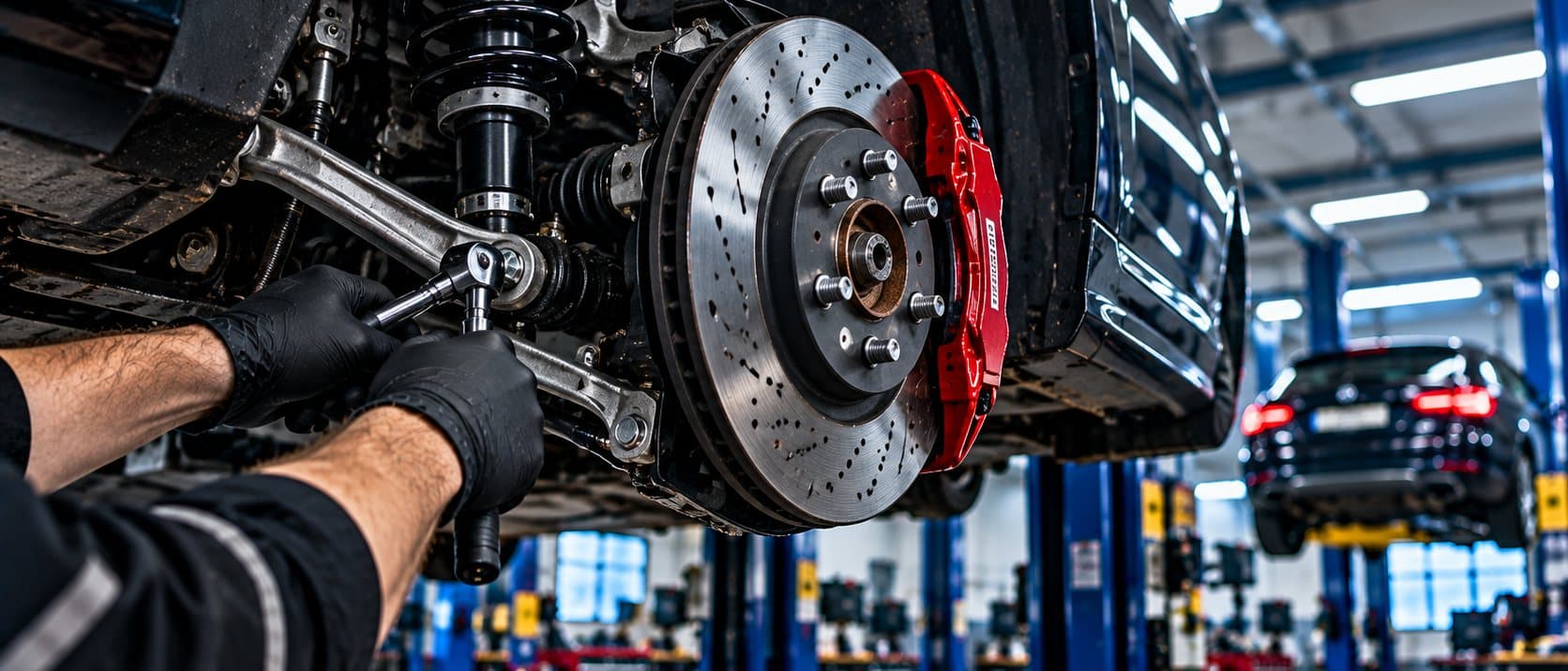
Press the pedal and you push fluid along pipes to a caliper at each wheel. The caliper squeezes a pair of pads against a steel disc turning with the wheel, and friction turns the car's motion into heat.
The fluid has to carry the force from your foot to the calipers without compressing, even when the brakes are hot. The Highway Code warns that low brake fluid may result in brake failure and a crash, and asks drivers to check fluid levels at least weekly. On the MOT, a reservoir below the minimum mark is a minor defect, significantly below it is major, and fluid that cannot be seen at all is dangerous.
Underneath sit rigid pipes and flexible hoses, and Leeds roads in winter are hard on them. An excessively corroded brake pipe is a major defect and a leaking pipe is dangerous, which is why a proper brake check includes a look underneath, not just at the wheels.
Brake fluid: level, condition and what the MOT checks
Brake fluid is the link between your foot and the wheels, and the Highway Code is direct about it: low brake fluid may result in brake failure and a crash, so check the level at least weekly along with the other fluids. A level that keeps dropping is not something to top up and forget; it means a leak or pads that are nearly worn out.
The MOT looks at the fluid as well as the level. The DVSA inspection manual grades a reservoir below the minimum mark as a minor defect, significantly below it as a major, and fluid you cannot see at all as dangerous. Fluid that is obviously contaminated is a major defect in its own right, which is why old, dark fluid can fail a car whose pads and discs are fine.
Brake fluid does not last for the life of the car. Its condition deteriorates with age and heat, which is why every manufacturer sets a change interval in the handbook. In the workshop we check the fluid's condition at the reservoir, not just the level, and tell you honestly whether a change is due.
How the MOT tests your brakes
Section 1 of the DVSA inspection manual covers brakes in two parts: condition and performance. For condition, the tester checks the pedal, servo, master cylinder, pipes, hoses, fluid reservoir, pads, discs or drums, the handbrake mechanism and the ABS and electronic parking brake warning lamps. A disc or drum must be significantly and obviously worn before it is failed; being below the manufacturer's limit is not in itself a reason.
For performance, the car goes on a roller brake tester unless its drive layout makes it unsuitable, in which case a decelerometer is used on a level road at about 20mph. The tester records the effort at each wheel, looks for fluctuation and grabbing, compares the two sides of each axle, and works out efficiency against the minimums for the service brake and handbrake.
Every defect is graded minor, major or dangerous. A car with only minor defects passes; any major or dangerous defect is a fail. With a dangerous defect you cannot drive the car away, and GOV.UK says driving with one can bring a fine of up to 2,500 pounds, three penalty points and a ban.
Brake and suspension repairs in Harehills
At NHG Vehicle Care on Dolly Lane in Harehills we carry out brake and suspension repairs on cars and vans: pads, discs, calipers, pipes and hoses, handbrake adjustment and brake fluid changes, alongside Class 4 and Class 7 MOTs. We measure what is left on the pads and discs and tell you plainly what needs doing now and what can wait.
If you have noticed any of the signs above, a brake check is quick and far cheaper than finding out the hard way. Call us on 0113 244 3544 or request a booking online. We are open Monday to Friday, 8:30am to 5:30pm.