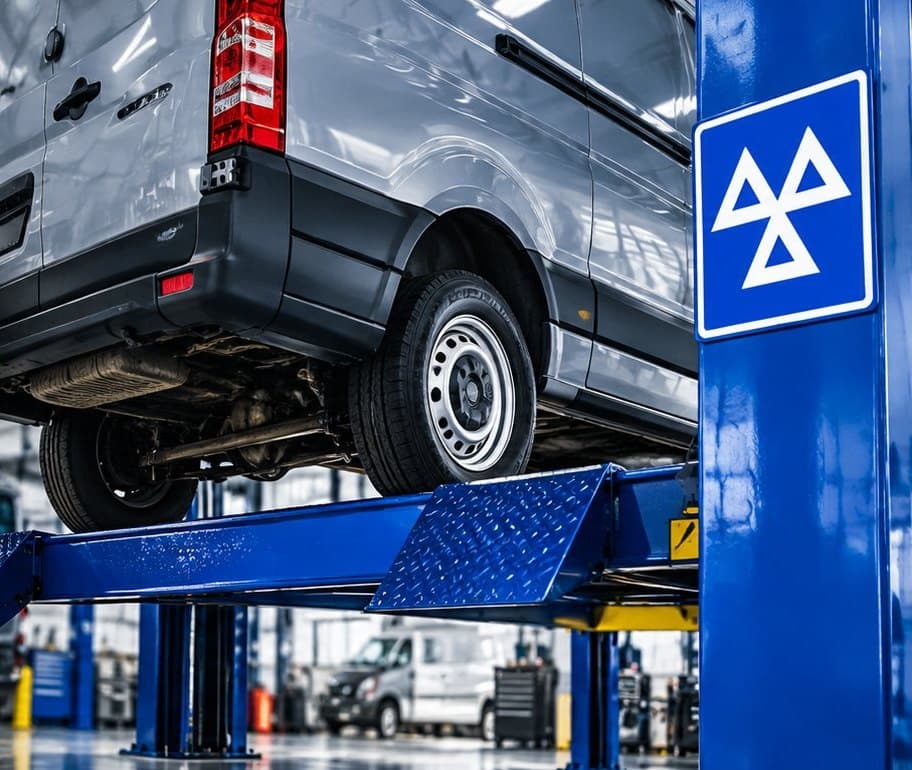

Tyres are the only part of your car that touches the road, and they are one of the few parts the law puts a number on. The Highway Code is blunt: cars, light vans and light trailers must have at least 1.6 mm of tread across the central three-quarters of the tyre and all the way round. Below that you are driving illegally, the car fails its MOT with a dangerous defect, and your stopping distance in the wet grows.
This guide covers what the law says, what it costs if you are caught, how to check your own tread, and what the way a tyre wears tells us about the car underneath it. We fit, balance and align tyres at our workshop on Dolly Lane in Harehills.
The law: 1.6 mm across the central three-quarters
The rule for a car or light van is in the Highway Code, Annex 6: a tread depth of at least 1.6 mm across the central three-quarters of the breadth of the tread and around the entire circumference. The shallowest point anywhere round the wheel is the one that counts.
The MOT inspection manual uses the same wording and classes tread below 1.6 mm as a dangerous defect, an automatic fail. It also says tyres of a different structure, radial and cross-ply for example, must not be mixed on the same axle and that different sizes on one axle are a major defect.
What it costs if you are caught
Using a vehicle with a defective tyre is an offence under section 41A of the Road Traffic Act 1988. The penalty table in the Road Traffic Offenders Act 1988 sets the maximum fine for a car at level 4 on the standard scale, which the Sentencing Act 2020 fixes at £2,500, and at level 5 for a goods vehicle or a vehicle with more than eight passenger seats. Endorsement is obligatory, with three penalty points, and the court can disqualify you at its discretion.
On your driving record the offence is code CU30, and GOV.UK says it stays there for four years from the date of the offence.
How to check your tread
The law measures tread across the central three-quarters of the width and around the whole circumference, so one glance at one spot proves nothing. Check each tyre in several places round its circumference, and on the inside edge as well as the outside, because tyres rarely wear evenly. A tread depth gauge costs a few pounds and gives you a reading in millimetres you can compare with the 1.6 mm minimum; if you would rather not, ask us to measure them while the car is on the ramp.
Tyre makers also mould small raised bars, called tread wear indicators, into the base of the main grooves; when the tread is level with them the tyre is at the limit. Grip in the wet depends on the grooves clearing water from under the tyre, so if you are close to the limit heading into a Leeds winter, replace early rather than late.
Tyre pressure and where to find the right figure
The Highway Code says tyres must be correctly inflated to the vehicle manufacturer's specification for the load being carried, and recommends checking weekly, before a journey, when the tyres are cold.
The correct pressures are on a placard, usually a sticker inside the driver's door shut or on the fuel filler flap, and in the handbook, with a higher figure for a full car. Use the car's figures, not the number moulded on the tyre, which is the maximum the tyre can take rather than what the car was designed for. At the MOT a tyre that is obviously under-inflated is a minor defect.
Wear patterns: what your tyres say about the car
A tyre that wears evenly across its width is doing its job. One that does not is telling you something about the car. We do wheel alignment and tracking at Dolly Lane alongside tyre fitting, and we check the suspension at the same time: a new tyre fitted without correcting what wore the old one just sets the clock running on the next.
- One edge worn: wheel alignment or tracking out, often after a kerb strike or a pothole
- Both edges worn: tyre has been running under-inflated
- Centre worn: tyre has been running over-inflated
- Patchy or scalloped wear, often with a drone or vibration: worn shock absorbers, suspension bushes or wheel balance
Balancing, pairs and when to replace
Every tyre we fit is balanced on the wheel before it goes back on the car. Balancing adds small weights to the rim so the wheel spins true; without it you feel a shake through the steering at speed, and the tyre and suspension joints wear faster.
The law only insists that both tyres on an axle are the same size and structure, but two matching tyres on an axle keep grip and braking even from side to side, which matters most in the wet. If the other tyre still has plenty of tread, a single replacement of the same size, speed rating and load index is fine. Beyond tread depth, replace any tyre with a cut deep enough to show the cords, a major defect at the MOT, or a lump, bulge or tear from the structure failing inside, which is dangerous. Do not drive on a bulging sidewall: it can let go without warning.
Tyre age, cracking and booking in
Rubber hardens and cracks with age even when the tread is deep, so a low-mileage car can have dangerous tyres that look almost new. The only legal age limit in the UK is for larger vehicles: the Highway Code says tyres over 10 years old must not be used on the front axles of goods vehicles over 3.5 tonnes or passenger vehicles with more than eight seats. There is no age limit in law for a car, but the same ageing is happening to your tyres.
You can date any tyre from the code on the sidewall, usually in a small oval window. It is four digits: the first two are the week of manufacture and the second two the year, so 2318 means the 23rd week of 2018. Fine cracking in the sidewall or the base of the grooves, a dry, brown look to the rubber, or one tyre far older than the rest of the set are all reasons to have it looked at.
If what you find is a worn edge, tread down near the wear bars or a crack you do not like, bring the car to us at Unit 2, 2 Dolly Lane, Harehills. We supply and fit tyres, balance and align the wheels, and check the suspension that wears them. Call 0113 244 3544 or request a booking online.